


 PLATFORM UPDATE:


Cationic amino acid-engineered peptide hydrogels for sustained and potent antigen delivery enabling single-administration vaccination
 *a
*a
Abstract
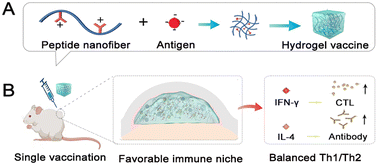
Peptide hydrogels have attracted considerable interest as vaccine delivery systems. This study systematically investigates how cationic residues affect peptide hydrogel-mediated antigen delivery and immune response, as well as the possibility of achieving single-dose immunization. Here, peptide Jelleine-1 (J-1) was employed as a template to generate peptide J-2, in which the type of cationic amino acid was modified, and peptide J-3, which lacks cationic residues. Peptides J-1, J-2, and J-3 self-assembled in antigen solutions to form hydrogel vaccines Gel 1, Gel 2, and Gel 3, respectively. Their mechanical properties, sustained antigen release, antigen uptake, and immune responses following single-dose administration were investigated. Results show that electrostatic interactions between cationic nanofibers and negatively charged antigens in Gel 1 and Gel 2 facilitated sustained antigen release and enrichment of macrophages and dendritic cells (DCs) at the injection site. Furthermore, cationic peptides induced DC membrane depolarization, which enhanced antigen uptake by 1.6-fold (Gel 1) and 1.8-fold (Gel 2) and increased DC activation by 3.3-fold and 3.1-fold, respectively. Ultimately, single administration of cationic peptide hydrogel vaccines Gel 1 and Gel 2 induced robust, long-lasting (up to 140 days), and balanced Th1/Th2 immune responses. These findings offer a conceptual framework for designing single-administration vaccine delivery systems.
 Please wait while we load your content...


