


 PLATFORM UPDATE:


2D nanoarchitectonics for exfoliated nanosheets: tailoring surface roughness of thin-film coatings

Abstract
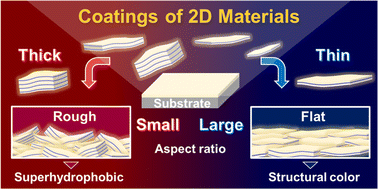
Liquid-phase exfoliation is a general route to obtain two-dimensional (2D) materials. Manipulation of colloidally dispersed nanosheets including monolayers, few-layers, and multi-layers is required for their applications. The exfoliated nanosheets are used in the assembled states with coating on substrates. However, the significant factors controlling the surface morphologies of the coatings are not fully elucidated in previous reports. In the present work, the morphologies are studied by changing the coating method and thickness of the nanosheets. The thinner nanosheets of graphene oxide and clay with the high aspect ratio provide homogenous flat films exhibiting noniridescent structural color by drop casting on a substrate. On the other hand, the water-repellent rough surfaces are formed by spraying the thicker titanate nanosheets with the low aspect ratio. The morphologies of the coatings can be controlled by the thickness and aspect ratio of the nanosheets. Based on these results, the superhydrophobic surface is designed by the two-step coatings; the primary flat coating covers a glass slide and secondary coating enhances the surface roughness. These insights can be applied to achieve tailored coating of 2D materials.
 Please wait while we load your content...


