


 PLATFORM UPDATE:


Enhanced solid-state electrochemiluminescence platform for selective sensing of glutathione via finely tuned, thickness dependent graphitic carbon nitride nanosheets

Abstract
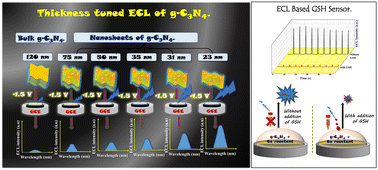
Compared with conventional luminophores, the metal-free two-dimensional semiconductor graphitic carbon nitride (g-C3N4) has emerged as a greener alternative luminophore in electrochemiluminescence (ECL)-based biosensing applications. Herein, for the first time, we investigated the thickness-dependent solid-state ECL changes in graphitic carbon nitride nanosheets (g-C3N4 N.S) modified on a glassy carbon electrode by synthesising an environmentally friendly, solvent-free thermal polycondensation method. Systematic spectral and morphological studies confirm that the optimized ratio of melamine to ammonium sulfate produces g-C3N4 N.S with a precisely tuned thickness. Ultrathin g-C3N4 N.S with a thickness of 23 nm significantly enhanced anodic and cathodic solid-state ECL intensities without any additional co-reactant during electrochemical cycling under ambient conditions and physiological pH (7.4). Particularly, the intensities of the cathodic and anodic solid-state ECL of g-C3N4 N.S (thickness 23 nm) were 12 and 2 times greater than that of bulk g-C3N4, as the g-C3N4 N.S electrocatalytically produced more reactive oxygen species (ROS) via the dissolved oxygen reduction reaction. Interestingly, when K2S2O8 was introduced as an external co-reactant, the same 23 nm-thick g-C3N4 N.S showed an impressive 205-fold increase specifically in cathodic ECL intensity even under air-saturated conditions. This effect became even more remarkable, reaching a 350-fold increase under oxygen-saturated conditions in the presence of both in situ and ex situ co-reactants in the electrolyte solution and showed stable solid-state ECL up to 180 seconds, with a color purity of 33.95%. This unique thickness-dependent surface-enhanced g-C3N4 N.S were used as a solid-state ECL platform for the selective detection of reduced glutathione (GSH), as a proof-of-concept experiment. The proposed g-C3N4 N.S-based ECL probe demonstrated unparalleled sensitivity, rapid response times, and unmatched accuracy for the detection of GSH concentrations ranging from 1.0 × 10⁻⁶ to 5.0 × 10⁻³ M, resulting in an LOD of 43 × 10−9 M in a human urine sample, with good recovery results. This study ignites inspiring insights into revolutionary approaches for quantifying GSH levels in urine, paving the way for significant advancements in non-invasive, stable, and accessible alternative medical diagnostics.
 Please wait while we load your content...


