


 PLATFORM UPDATE:


Exploring the insertion mechanism of pseudocapacitive perovskite oxide La–Ni–Co–O anode materials and the application to Li-ion capacitor and Li-based dual ion batteries
 *a
*a
Abstract
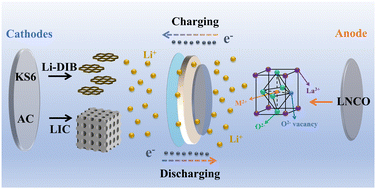
Different proportions of La-based perovskite oxide La–Ni–Co–O were synthesized by a co-precipitation procedure using metal nitrate as the starting material in this work. X-ray diffraction (XRD) results confirmed the formation of a perovskite oxide, La–Ni–Co–O/La2O3 (denoted as LNCO/LO). Electrochemical tests on perovskite oxides with varying ratios demonstrated that the LNCO(1 : 3)/LO composite exhibited optimal performance (294.9–189.3 mAh g−1/0.1–3.2 A g−1/146% retention/1000 cycles/2 A g−1). Ex situ XRD and XPS reveal that the LNCO(1 : 3)/LO electrode exhibits an insertion mechanism for Ni and Co electroactive sites for Li-ion storage. In addition, La2O3 plays a supporting and filling role in the system. Electrochemical kinetic analysis reveals that the LNCO(1 : 3)/LO material is primarily controlled by pseudocapacitor behavior, with the proportion of pseudocapacitor control increasing as the sweep speed increases. Interestingly, the optimal ratio of perovskite material LNCO(1 : 3)/LO is first applied to LNCO(1 : 3)/LO//activated carbon (AC) LICs and LNCO(1 : 3)/LO//graphite (KS6) Li-DIBs, and research has found that it has excellent performance, indicating that perovskite materials have broad application prospects in the field of lithium-ion capacitors and lithium-dual-ion batteries.
 Please wait while we load your content...


