


 PLATFORM UPDATE:


Rational design of hierarchical CuO/Cu2O/SnO2 branched supernanowires for highly sensitive non-enzymatic glucose sensors

Abstract
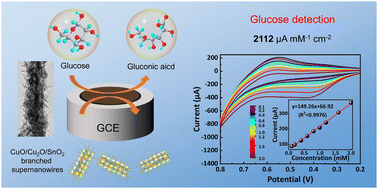
The rational design and synthesis of one-dimensional hierarchical heterojunction materials for high-performance electrocatalytic applications present an enticing prospect in the field of electrochemistry. Herein, barnyardgrass-like CuO/Cu2O/SnO2 branched supernanowires were rationally designed and controllably prepared via a synergistic process of co-precipitation and microwave treatment to achieve highly sensitive non-enzymatic glucose sensors. These prepared CuO/Cu2O/SnO2 ternary hierarchical heterostructures possessed a specific surface area of 102.92 m2 g−1, an abundance of active sites, and a markedly superior propensity for glucose oxidation. Impressively, these prepared barnyardgrass-like CuO/Cu2O/SnO2 branched supernanowire glucose sensors demonstrated the desired electrocatalytic properties for glucose with an elevated sensitivity of 2112 μA mM−1 cm−2 and a low detection limit of 33.3 μM. Furthermore, they exhibited good stability, selectivity, reproducibility and a high recovery of 99.7%. These hierarchically structured nanomaterials are promising candidates for high-performance electrochemical applications.
 Please wait while we load your content...


