


 PLATFORM UPDATE:


Boosting magnetoresistance in manganese phosphide helimagnets through iron oxide interface strain engineering
 *a
Anh Tuan
Duong,
c
Humberto Rodriguez
Gutierrez,
a
Manh-Huong
Phan
*ad
*a
Anh Tuan
Duong,
c
Humberto Rodriguez
Gutierrez,
a
Manh-Huong
Phan
*ad
Abstract
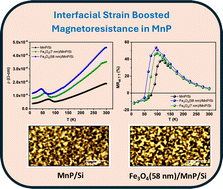
Helimagnetic materials exhibit complex non-collinear spin structures, making them promising candidates for next-generation magnetoresistive devices. Their unique magnetic textures can yield enhanced magnetoresistance effects compared to conventional materials, potentially improving the performance of magnetic sensors and memory technologies. In this study, an interface engineering strategy is presented that leverages strain induced by the structural phase transition of Fe3O4 to enhance the magnetoresistance (MR) effect in nanostructured manganese phosphide (MnP) films near the ferromagnetic-to-helimagnetic (FM–HM) transition. MnP films (∼100 nm thick, grain size ∼86 nm) were grown on Si substrates using molecular beam epitaxy, followed by deposition of Fe3O4 layers of varying thicknesses (7 nm and 58 nm). The results show that a thin Fe3O4 layer (7 nm) enhances interfacial magnetic coupling and overall magnetization in the bilayer, while the thicker Fe3O4 layer (58 nm) dominates the magnetic response due to its soft magnetic nature. Remarkably, the MR near the FM–HM transition increases by 20% and 37% with the 7 nm and 58 nm Fe3O4 layers, respectively, attributed to strain-enhanced spin-dependent scattering at the interface. These findings provide new insights into strain-modulated magnetic coupling at iron oxide/helimagnet interfaces and underscore their potential for advanced spintronic applications.
 Please wait while we load your content...


