


 PLATFORM UPDATE:


Impact of Bi3+ and Cu2+ doping on the optical and electronic properties of CsPbBr3 for photocatalytic toluene oxidation
 a
David
Llorens Rauret,
c
David
Berardan,
b
Jordi
Arbiol,
cd
Mohamed Nawfal
Ghazzal
*a
a
David
Llorens Rauret,
c
David
Berardan,
b
Jordi
Arbiol,
cd
Mohamed Nawfal
Ghazzal
*a
Abstract
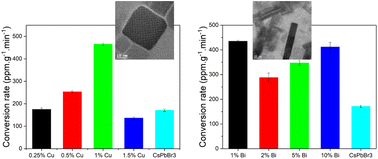
Doping of metal halide perovskites (MHPs) offers an opportunity to introduce trap states that are reported to be beneficial for the charge carrier dynamics. Herein, we investigated the electronic structure–photocatalytic relationship of CsPbBr3 doped with Bi3+ and Cu2+ cations. Bi doping necessitates a reduction in the hot-injection temperature to avoid the formation of Bi nanoparticles, leading to the formation of two-dimensional CsPbBr3 with a variable aspect ratio. Bi doping causes no significant changes in the band gap energy but leads to the gradual appearance of a band-tail in the absorbance spectrum and a broad-band emission peak covering a large wavelength range. A photoluminescent quenching is observed as the ratio of Bi3+ increases, indicating shallow trap generation. Cu2+ doping does not affect the morphology of the 3D crystalline CsPbBr3 and shows a photoluminescent blueshift, which translates to a change in the bandgap energy. The CsPbBr3 doping, with an adequate amount of Cu, provides the best photocatalytic activity, surpassing Bi-doped CsPbBr3. Time-resolved photoluminescence analysis indicated that Bi3+ introduces a shallow trap that captures electrons while leaving the holes free, leading to an increase in the charge carrier lifetime, thus favoring charge carrier separation. Unlike bismuth, Cu2+ affects both the conduction and valence band positions, making the oxidation reaction more favorable.
 Please wait while we load your content...


