


 PLATFORM UPDATE:


Impact of high oxygen deficiency on the photoluminescence properties of black zinc oxide thin films

Abstract
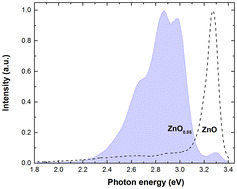
The presence of oxygen deficiency in ZnO thin films is a key factor for tailoring their optical and electrical properties. Highly oxygen-deficient zinc oxide thin films were synthesized by pulsed electron beam deposition and investigated by Rutherford backscattering spectrometry, photoluminescence, X-ray diffraction, Hall effect measurements, and X-ray photoelectron spectroscopy. At a high degree of deficiency of about 15%, leading to black (or dark) films, zinc oxide films were found to be amorphous. The optical properties are dominated by the introduction of deep-level defect states that absorb visible light, whereas the electrical properties are governed by the increased electron concentration in the conduction band (6.55 × 1020 cm−3). These oxygen-deficient zinc oxide films exhibited enhanced violet and blue photoluminescence emission in the range of 408–456 nm, attributed to zinc interstitials and their extended states.
- This article is part of the themed collection: Celebrating International Women’s day 2026: Women in Nanoscience
 Please wait while we load your content...


