


 PLATFORM UPDATE:


CoFe-NaYF4:Yb/Er@SMPC derived carbon film: integrated precise stimuli-responsive NIR photothermal sensing and shape-memory performance
 a
Sainan
Wei
*ac
and
a
Sainan
Wei
*ac
and
Abstract
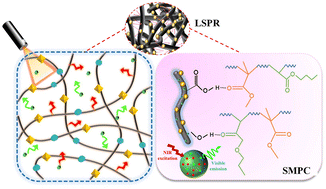
Photothermal fillers combined with shape-memory polymers (SMPs) enable light-triggered shape memory. The combination of metal particles and biomass-sourced carbon materials has emerged as a significant new research hotspot in the field of photothermal applications and sustainable development. By utilizing biomass-derived carbon films as flexible substrates and encapsulating SMPs, smart textiles based on photothermal-responsive shape-memory polymers can be developed. To date, this area has received limited attention from the research community. Furthermore, near-infrared (NIR) lasers have been widely applied in both remote military laser targeting and activating shape-memory (SM) behavior in polymers due to their relative safety with respect to human tissues and strong penetration capabilities. Nevertheless, the invisibility of NIR cannot be overlooked. Herein, NaYF4:99.5%Yb/0.5%Er can convert 980 nm NIR light into visible light and thermal energy, demonstrating its feasibility as a multifunctional photothermal filler. With the assistance of up-conversion at a low power density of 200 mW cm−2, the position of the laser beam on the SMP surface can be clearly detected, enabling remote targeting of specific deformation-triggering regions. By introducing acrylate polymers into cotton-derived carbon films loaded with CoFe alloy particles, the entangled fiber network provides ample chain mobility for the polymer, leading to the successful fabrication of functionalized light-responsive shape-memory polymers (CNSC-xYb). Upon NIR excitation, the surface temperature at the folded position of CNSC-99.5Yb reaches 127.2 °C within 3 s, and within the range of 0° to 90°, the maximum deformation angle is approximately 72°. This material not only exhibits excellent photothermal responsiveness but also rapid shape-changing ability. These characteristics enable precise triggering of SMPCs using invisible NIR, offering novel design concepts and application prospects for smart textiles, soft robotics, and remotely controllable intelligent material systems.
 Please wait while we load your content...


