


 PLATFORM UPDATE:


Optimizing MnNi2S4 electrode performance via sulfur precursor selection: a comparative study for high-rate supercapacitor applications

Abstract
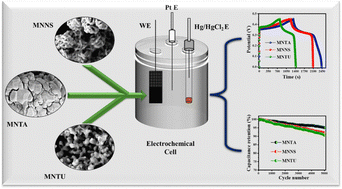
Ternary spinel-type transition metal sulphides like MnNi2S4 are promising supercapacitor electrodes due to their high theoretical capacitance and redox activity. However, the significance of sulfur precursor selection on the structural and electrochemical behaviours of MnNi2S4 remains under investigation. In this work, MnNi2S4 nanostructures were developed utilizing three sulfur sources: thioacetamide, sodium sulphide, and thiourea, to explore their impact on material characteristics and electrochemical performance. XRD confirmed the formation of the spinel MnNi2S4 phase for all samples, with the thioacetamide-derived material exhibiting the highest crystallinity. Raman spectroscopy revealed enhanced lattice ordering in the same sample, as evidenced by stronger vibrational peaks. However, BET surface area analysis showed that sodium sulphide and thiourea-based samples had larger surface areas, and FE-SEM and TEM analyses demonstrated that the thioacetamide-derived sample had a more favourable interconnected nanostructure. Electrochemical measurements, including CV, GCD, and EIS, established that the thioacetamide-based electrode provided an excellent electrochemical performance, as evidenced by the highest Cs of 2477.77 F g−1 at 1 A g−1, and improved rate capability with capacitance retention of 95.09% over 5000 cycles. These findings highlight the importance of precursor chemistry to optimize MnNi2S4 for energy storage applications, and they validate thioacetamide as a superior sulfur source for supercapacitor electrode development.
 Please wait while we load your content...


