


 PLATFORM UPDATE:


Green-synthesized silver nanoparticle incorporated poly(para-phenylenediamine)/MWCNT conductive nanocomposite for enhanced antibacterial activity and photocatalytic degradation of methylene blue dye
 *a
Xiang
Li
d
*a
Xiang
Li
d
Abstract
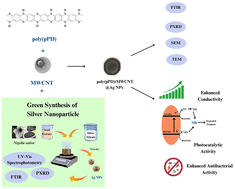
Addressing environmental and biological issues requires the fabrication of multifunctional nanocomposites that provide photocatalytic and antibacterial functions. In this study, we report the successful formulation of a ternary nanocomposite composed of poly(para-phenylenediamine) (poly(pPD)) and Ag nanoparticles (NPs) synthesized from Nigella sativa seed extract, decorated on multi-walled carbon nanotubes (MWCNTs). The nanocomposite was characterized by spectroscopic and microscopic techniques, which demonstrated that MWCNTs and spherical Ag NPs were integrated into the polymer matrix. The ternary poly(pPD)/MWCNT@Ag NP nanocomposite exhibited greater antibacterial activities against Gram-positive and Gram-negative bacterial strains than the binary poly(pPD)/MWCNT nanocomposite. The enhanced antibacterial effect was due to the presence of Ag NPs in the ternary nanocomposite. The enhanced conductivity of the nanocomposite compared to pristine poly(pPD) indicates its improved interfacial compatibility with the nanofillers, potentially allowing efficient charge separation and transfer, and producing a degradation value of 89.6% for methylene blue under visible light. The ˙OH, ˙O2−, and h+ species might synergistically contribute to this photocatalytic degradation. We evaluate the benefits of polymer isomerism, carbon nanotube support, and green-synthesized silver nanoparticles (Ag NPs) in developing a sustainable multifunctional nanocomposite for environmental remediation and antibacterial applications.
 Please wait while we load your content...


