


 PLATFORM UPDATE:


Fabrication of Co(OH)F catalyst for efficient peroxymonosulfate activation in sulfamethazine degradation
 *a
Gang
Ni
*b
*a
Gang
Ni
*b
Abstract
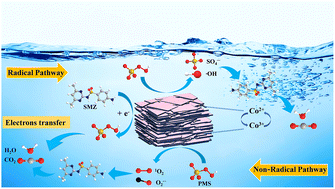
In this work, a cobalt-based catalyst with a two-dimensional nanosheet structure, Co(OH)F, was synthesized and applied for peroxymonosulfate (PMS) activation to remove sulfamethazine (SMZ) from water. Comprehensive characterization confirmed its distinct morphology and physicochemical features. Relative to conventional cobalt catalysts, the material showed markedly enhanced performance, achieving almost complete SMZ elimination within 10 min and exhibiting a high pseudo-first-order rate constant of 0.999 min−1. The influence of operational factors, including reaction system type, pH, initial pollutant level, PMS dosage, catalyst amount, and coexisting ions, was systematically examined. Among these, H2PO4− was found to significantly promote PMS activation, suggesting a synergistic role. The nanosheet configuration improved PMS adsorption and exposed plentiful active sites. Durability tests indicated consistent activity over five successive runs, demonstrating structural stability and recyclability. Mechanistic investigations identified singlet oxygen (1O2) as the predominant reactive species, with degradation proceeding mainly via a non-radical route. This study presents an efficient Co(OH)F catalyst and clarifies its non-radical activation process, offering theoretical and practical guidance for eliminating emerging contaminants.
 Please wait while we load your content...


