


 PLATFORM UPDATE:

Electronic modulation of single and dual-atom Ru catalysts for N2 activation by nanosheet supports
 *ac
*ac
Abstract
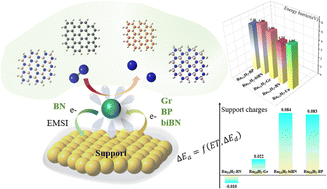
Supported metal catalysts exhibit excellent catalytic activity in N2 activation and serve as crucial materials for N![[triple bond, length as m-dash]](https://www.rsc.org/images/entities/char_e002.gif) N triple bond cleavage. However, the mechanism of supports in facilitating this bond cleavage and its relationship with the N2 activation energy barrier (Ea) at the atomic and electronic level remain unclear. In this study, we employed density functional theory (DFT) calculations to investigate the structures, energetics, orbital interactions, and electron transfer during N2 activation on Ru single-atom catalysts (Ru-SACs) with and without supports. From the perspective of catalysts, we demonstrate that catalysts with electron-withdrawing supports are more conducive to N2 activation. From the perspective of mechanism, the electronic metal–support interaction (EMSI) modulates the Ea of the N2 activation on supported Ru-SACs by regulating the electron transfer (ET) between the Ru atom and supports. Furthermore, the synergistic effect of EMSI and N2 adsorption controls the energy separation (Ed) between the d-band center (εd) and the Fermi level (Ef) of the Ru 4d orbits, thereby modulating the Ea of N2 activation. The ET and Ed are two potentially important catalyst descriptors affecting the Ea value. Some key findings about the effect of the support in the Ru-SAC systems are rather consistent with those in the case of dual Ru and Os atom catalysts, which have much lower Ea. As a whole, this report provides deeper insights into the effect of the support on single and dual atom metal catalysts for N2 activation, and can help design better ammonia-synthesis catalysts in the future.
N triple bond cleavage. However, the mechanism of supports in facilitating this bond cleavage and its relationship with the N2 activation energy barrier (Ea) at the atomic and electronic level remain unclear. In this study, we employed density functional theory (DFT) calculations to investigate the structures, energetics, orbital interactions, and electron transfer during N2 activation on Ru single-atom catalysts (Ru-SACs) with and without supports. From the perspective of catalysts, we demonstrate that catalysts with electron-withdrawing supports are more conducive to N2 activation. From the perspective of mechanism, the electronic metal–support interaction (EMSI) modulates the Ea of the N2 activation on supported Ru-SACs by regulating the electron transfer (ET) between the Ru atom and supports. Furthermore, the synergistic effect of EMSI and N2 adsorption controls the energy separation (Ed) between the d-band center (εd) and the Fermi level (Ef) of the Ru 4d orbits, thereby modulating the Ea of N2 activation. The ET and Ed are two potentially important catalyst descriptors affecting the Ea value. Some key findings about the effect of the support in the Ru-SAC systems are rather consistent with those in the case of dual Ru and Os atom catalysts, which have much lower Ea. As a whole, this report provides deeper insights into the effect of the support on single and dual atom metal catalysts for N2 activation, and can help design better ammonia-synthesis catalysts in the future.
 Please wait while we load your content...


