


 PLATFORM UPDATE:


Enthalpies of formation of some N-oxide bitetrazole salts
 *a
Leonid L.
Fershtat
*a
and
*a
Leonid L.
Fershtat
*a
and
Abstract
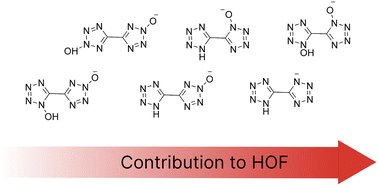
Unlike the widely studied bitetrazole dioxides, bitetrazole N-oxide salts have been poorly studied, although data on their structure and thermochemical properties, as promising high-energy materials, are important from both practical and theoretical points of view. Using a combination of quantum chemistry methods, atom–atom potentials, and additive schemes, we modeled the structure and calculated the enthalpies of formation of various bitetrazoles and their N-oxides. To simulate crystal packings and search for optimal ones corresponding to their global minimum of the potential energy surface (PES), the starting crystal packings were constructed and their parameters (lattice lengths and molecular arrangements within them) were minimized in fifteen space groups (P21/c, P212121, P![[1 with combining macron]](https://www.rsc.org/images/entities/char_0031_0304.gif) , P21, Pbca, C2/c, Pna21, Pca21, Cc, C2, P1, Pbcn, P31, R
, P21, Pbca, C2/c, Pna21, Pca21, Cc, C2, P1, Pbcn, P31, R![[3 with combining macron]](https://www.rsc.org/images/entities/char_0033_0304.gif) , and Pc), which cover almost 95% of the experimentally studied crystal structures of organic compounds, cocrystals, and salts. The results of crystal packing simulations for the compounds under consideration are presented. The enthalpies of formation were calculated using the original MICCM method (mixing ion components and cocrystals), which takes into account the contributions of various salt components of the thermal decomposition process. The effect of introducing N-oxide groups into the structure of bitetrazoles is considered.
, and Pc), which cover almost 95% of the experimentally studied crystal structures of organic compounds, cocrystals, and salts. The results of crystal packing simulations for the compounds under consideration are presented. The enthalpies of formation were calculated using the original MICCM method (mixing ion components and cocrystals), which takes into account the contributions of various salt components of the thermal decomposition process. The effect of introducing N-oxide groups into the structure of bitetrazoles is considered.
 Please wait while we load your content...


