


 PLATFORM UPDATE:


π-Delocalization and aromaticity as key factors in regioselective ring closure of fused triazolopyrimidines: an experimental–theoretical approach

Abstract
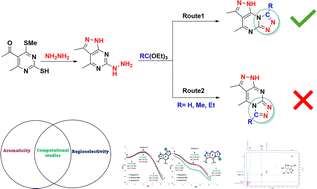
This study presents a comprehensive synthetic and computational investigation of the regioselective ring-closing reactions in the synthesis of three pyrazolo[4,3-e][1,2,4]triazolo[4,3-a]pyrimidine (PTP) derivatives, namely 3-H, 3-Me, and 3-Et. In a combined experimental and theoretical approach, we investigate the effective kinetic and thermodynamic factors in the preference of two competitive reaction pathways (route 1 and route 2). Advanced aromaticity indices such as nucleus-independent chemical shift (NICS), anisotropy of the current-induced density (ACID), localized orbital locator (LOL), AV1245, and multi-center bond order (MCBO), in combination with quantum theory of atoms in molecules (QTAIM) and natural bond orbital (NBO) analyses, revealed that π-electron delocalization is the principal driver of regioselectivity. The results demonstrate that route 1, which possesses stronger π-delocalization and enhanced aromatic stabilization in both the transition state (TS4) and the final product (product 1), is kinetically and thermodynamically favored across all substituents. Notably, the Me and Et derivatives exhibit more powerful aromatic stabilization compared to the H derivative, which leads to lower activation energies and more negative Gibbs free energy changes. These findings highlight the critical role of aromaticity in directing the regioselective formation of fused heterocyclic systems and offer valuable insights for the design and synthesis of bioactive PTP-based compounds.
 Please wait while we load your content...


