


 PLATFORM UPDATE:


A symmetric cascade of dinitrotriazine and dinitropyrimidine rings on a central triazine core: computational investigation of probable heat-resistant energetic materials
 *a
and
Srinivas
Dharavath
b
*a
and
Srinivas
Dharavath
b
Abstract
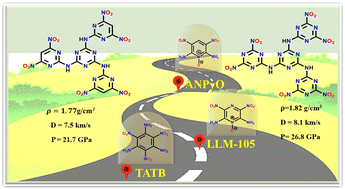
Exploring high-nitrogen energetic molecules and their structure–property relationships represents a dynamic and evolving area of research in energetic materials science. In this work, two heat-resistant energetic materials with dinitrotriazine and dinitropyrimidine rings connected to a central triazine core via –NH– linkages were designed. Their physicochemical and energetic properties were investigated by using density functional theory (B3LYP/6-311G(d,p)). Both designed compounds exhibit a positive heat of formation that surpasses well-known heat-resistant explosives, 2,2′,4,4′,6,6′-hexanitrostilbene (HNS), 1,3,5-triamino-2,4,6-trinitrobenzene (TATB), 2,6-bis(picrylamino)-3,5-dinitropyridine (PYX), 2,2′,2′′,4,4′,4′′,6,6′,6′′-nonanitroterphenyl (NONA), and 2,6-diamino-3,5-dinitropyrazine-1-oxide (LLM-105), due to the presence of endothermic triazine and pyrimidine rings in their structures. The presented compounds demonstrate detonation performances (D > 7.5 km s−1, P > 21.7 GPa) superior to HNS and comparable to those of TATB, PYX, NONA, and 2,4,6-tri(3,5-diamino-4-nitropyrazol-1-yl)-1,3,5-triazine (NPX-02). Electrostatic potential, electron localization function, and different aromaticity indexes were also examined and compared with traditional heat-resistant explosives. Additionally, they possess a high C–NO2 bond strength (>220 kJ mol−1), a lower heat of detonation (Q < 1100 cal g−1), and a better safety factor (>400), indicating their low sensitivity. These computationally derived physicochemical and energetic properties make them promising candidates for further research and potential application as insensitive and heat-resistant energetic materials; however, additional experimental efforts are required to validate the predicted properties.
 Please wait while we load your content...


