


 PLATFORM UPDATE:


Sustainable Cu2WS4–cellulose composites for high-performance supercapacitors: synergistic effect of a metal sulfide and a biopolymer matrix

Abstract
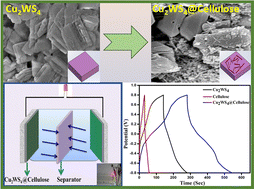
The rising demand for sustainable and efficient energy storage technologies has spurred significant interest in high-performance supercapacitors. Among various candidates, transition metal chalcogenides (TMCs), such as Cu2WS4, have emerged as promising materials owing to their intrinsic layered structure, multiple redox-active sites, and high electrical conductivity. Nevertheless, their practical implementation is often hindered by issues like agglomeration and inadequate mechanical stability. Herein, we report the synthesis of a Cu2WS4@cellulose composite via a hydrothermal-assisted strategy, wherein cellulose functions as a flexible, porous, and hydrophilic matrix to improve structural robustness and ion diffusion pathways. A thorough electrochemical assessment in 6 M KOH electrolyte demonstrated a high specific capacitance of 537.14 F g−1 at a scan rate of 10 mV s−1, along with outstanding rate capability and long-term cycling durability, retaining 91.04% of its initial capacitance after 10 000 cycles. Additionally, a symmetric supercapacitor assembled from the composite achieved a maximum energy density of 58.60 Wh kg−1 at a power density of 800.99 W kg−1. The device was also able to power LEDs of various colours, highlighting its potential for real-world energy storage applications. The outstanding performance is ascribed to the synergistic integration of Cu2WS4 nanoflakes with the cellulose scaffold, which enhances electronic conductivity, prevents structural collapse, and facilitates rapid ion transport. This study underscores the promise of Cu2WS4@cellulose as a next-generation electrode material for environmentally sustainable and high-efficiency energy storage systems.
 Please wait while we load your content...


