


 PLATFORM UPDATE:


Tragacanth gum-based Cr-doped MnO2/clay nanocomposite: a dual adsorbent for reactive yellow dye and CO2

Abstract
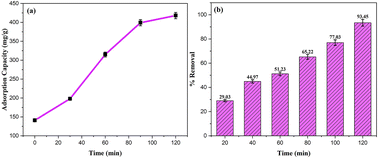
It is becoming increasingly challenging to develop environmentally friendly and safe methods for purifying water contaminated with dyes. In this work, we developed a cost-effective and secure strategy for creating an effective adsorbent for the adsorptive removal of RY 18 dye. A biopolymer, namely, tragacanth gum-based Cr-doped MnO2 NP/clay (GCMC) composite, was fabricated using a one-pot approach for wastewater treatment. Various characterization techniques, including XRD, FTIR spectroscopy, SEM, BET analysis, and zeta potential analysis, confirmed the formation of the adsorbent. The strong diffraction peaks in the XRD pattern of GCMC indicated the high crystallinity of the composite, with the crystallite size estimated to be around 57.69 nm. SEM analysis revealed a well-defined structure consisting of distributed particles with a rod-like morphology having an average diameter of about 5.38 μm. The stability of the GCMC composite was confirmed by zeta potential analysis, which showed a value of −22.42 mV, indicating sufficient electrostatic repulsion between the particles. The adsorption capacity and percentage of removal of RY 18 dye were determined to be 418 mg g−1 and 93.45%, respectively, as confirmed by a UV-visible spectrometer. The Temkin and intra-particle diffusion models were the best isothermal adsorption and kinetic models, with correlation coefficient values of 0.978146 and 0.99962, respectively. The recycling experiment suggested that the prepared adsorbent had high stability. In addition to expanding CO2 adsorption capabilities, the developed GCMC composite showed outstanding consistency. With increasing CO2 pressure and adsorption temperature, CO2 adsorption exhibited endothermic reaction characteristics, as indicated by the higher R2 values of 0.9994, 0.9883, and 0.9877. CO2 adsorption followed the liquid-film diffusion model at 25 °C, 40 °C, and 55 °C. The GCMC composite is a viable option for the adsorptive removal of dyes from polluted water due to its affordable and effective adsorption process.
 Please wait while we load your content...


