


 PLATFORM UPDATE:


Synthesis, structure investigation and evaluation of anti-orthopoxvirus activities of 2-(2-arylethenyl)imidazoles
 a
Vyacheslav I.
Krasnov,
c
Dmitriy N.
Polovyanenko,
c
Ivan A.
Moskalev,
d
Sergey G.
Arkhipov,
d
Olga I.
Yarovaya
c
and
Polina A.
Nikitina
*a
a
Vyacheslav I.
Krasnov,
c
Dmitriy N.
Polovyanenko,
c
Ivan A.
Moskalev,
d
Sergey G.
Arkhipov,
d
Olga I.
Yarovaya
c
and
Polina A.
Nikitina
*a
Abstract
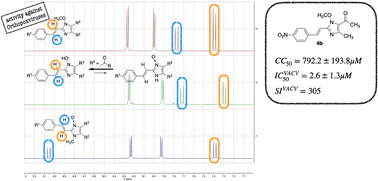
The continuing worldwide mpox outbreak (2022–present) provokes interest in the search for new small organic molecules possessing anti-viral activity against orthopoxviruses. In the course of this search a series of new 2-(2-arylethenyl)imidazoles were synthesized. Structural features of these derivatives were studied by means of NMR spectroscopy and single-crystal X-ray diffraction analysis. It was not surprising that all the title compounds were trans-isomers. Prevailing tautomers for 2-(2-arylethenyl)-1-hydroxyimidazoles were determined. If a carbonyl-containing substituent was present at position 5 of the imidazole, then the compound existed predominantly in a N-hydroxy-tautomeric form both in the gaseous phase and in solution in polar aprotic solvents. In crystal form, either a single N-hydroxy-tautomer or a mixture of both tautomers (N-hydroxyimidazole and imidazole N-oxide) were observed. For 2-(2-arylethenyl)-1-hydroxy-4,5-dimethylimidazoles in solution in polar aprotic solvents an equilibrium mixture of both tautomers in rapid interconversion was registered. Predominant conformers were determined for the 1-hydroxyimidazoles, 1-methoxyimidazoles, and 1-methylimidazole 3-oxides under consideration. Cytotoxicity and virus-inhibiting activity against Vaccinia virus were evaluated in vitro for all the imidazole derivatives under study. 2-(2-Arylethenyl)-1-methoxyimidazoles were determined to be the most promising. They also exhibited activities against zoonotic orthopoxviruses such as Cowpox virus and Mousepox (Ectromelia) virus. The lead compound 1-(1-methoxy-4-methyl-2-((E)-2-(4-nitrophenyl)ethenyl)-1H-imidazol-5-yl)ethanone 4b demonstrated the highest selectivity index against Vaccinia virus (SI = 305).
 Please wait while we load your content...


