


 PLATFORM UPDATE:


Electrohydrodynamically formed core–shell structure of chitosan–starch composite microparticles for induced surface functionality and phased release of bioactive species

Abstract
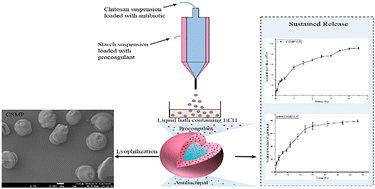
Microparticles from biopolymers with multiple functionalities are sought after in many controlled release applications. As an example, ultra-porous hemostatic materials with the option of dual delivery of procoagulant and antibacterial agents are highly advantageous for wound management. In this study, uniform microcapsules with a core–shell structure at the sub-millimeter scale were fabricated using electrostatic flow to disintegrate the core-sheath filament. The chitosan at the core contained gentamicin as an antibacterial agent, whereas crosslinked starch as the shell was loaded with tranexamic acid (TA) to serve as blood pro-coagulant. The stretching of the core-sheath filament under electrostatic force and subsequent disintegration in a stable cone-jet mode, resulted in highly uniform microcapsules of diameter 180 ± 20 μm, which apparently was much smaller than the dimension of the nozzle. Characterization of the core–shell structure was performed through scanning electron microscopy (SEM), Fourier-transform infrared spectroscopy (FTIR), and nitrogen adsorption–desorption analysis, confirming the distinct compartmentalization and with intrinsic porosity at the mesoscale. These properties enabled large uptake of water soluble drugs or blood procoagulant, as well as offering a scaffold for absorption of plasma or wound exudate, and providing surface area for adhesion and/or aggregation of platelets. The developed microparticles exhibited a water absorption capacity of 462.3% and underwent 80% biodegradation over an 8-day period, indicating their suitability for wound management. The burst release of TA from the shell (over a timescale of ∼4 h), and sustained release of gentamicin from the core (over a timescale of ∼72 h) were demonstrated.
 Please wait while we load your content...


