


 PLATFORM UPDATE:


Effect of ligand denticity on the removal of 238Pu from dilute aqueous solutions by hydroxamate-based chelating gels
 a
Osian
Fonquernie,
b
Floriane
Mangin,
b
Stéphane
Brandès,
b
Josselin
Gorny,
c
Michel
Meyer,
*b
Jean-Claude
Chambron
*a
and
Laureline
Février
*d
a
Osian
Fonquernie,
b
Floriane
Mangin,
b
Stéphane
Brandès,
b
Josselin
Gorny,
c
Michel
Meyer,
*b
Jean-Claude
Chambron
*a
and
Laureline
Février
*d
Abstract
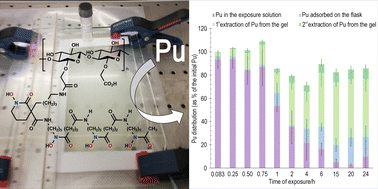
Plutonium (Pu) is a chemically and radiologically toxic element, primarily of anthropogenic origin. Reagents that specifically sequester Pu have been developed in the frame of nuclear waste processing and storage. Other potential applications of Pu chelators are in vivo decorporation and environmental remediation. Although the medical application has been addressed for a long time by the development of Pu-specific binders, studies concerning the environmental application are scarce. A desferrioxamine-B ([(DFO)H4]+)-derived tetrahydroxamate chelator, 1H4, which was originally designed for the sequestration of Zr4+ for 89Zr-ImmunoPET applications, was grafted on a commercial hydrophilic resin, CM Sephadex C-25®. The resin beads were subsequently embedded in an agarose gel, and the resulting material was used for the extraction of 238Pu(IV) from dilute aqueous solutions at pH 6.5. Comparison of the results with those obtained using the commercial Chelex®-100 resin and the H3DFO-based CM Sephadex C-25® extracting materials showed that Pu was more strongly bound to the 1H4-functionalized resin than to Chelex®-100 and the H3DFO-based resins, which confirms that the tetrahydroxamate chelator 14− forms a more stable Pu(IV) complex than the trihydroxamate DFO3− siderophore. The fabricated material could be considered in the development of diffusive gradients in thin-films (DGT) devices for the environmental monitoring of Pu.
 Please wait while we load your content...


