


 PLATFORM UPDATE:


Dicobalt tetracarboxylate complexes with labile axial ligands

Abstract
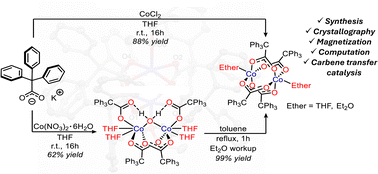
Dirhodium tetracarboxylate complexes catalyze a number of useful carbenoid transformations including cyclopropanation and C–H functionalization. However, complementary reactivity involving dicobalt tetracarboxylate complexes is significantly less developed; only cyclopropanation has been previously reported. The vast majority of dicobalt paddlewheel complexes reported to date have strongly coordinating N-donor axial ligands that are poisons known to arrest the catalytic activity of dirhodium complexes. We therefore sought a synthetic route to form dicobalt paddlewheel complexes that bear labile, O-donor axial ligands and report herein the synthesis of Co2(TPA)4(L)2, where TPA = triphenylacetate and L = Et2O (2) or THF (3), via two different synthetic routes. Magnetic susceptibility measurements of 3 have been performed and the data were fitted to a model incorporating isotropic exchange and zero-field splitting of the Co(II) centers. We reinvestigate the mechanism of magnetic exchange in paddlewheel-type Co(II) dimers finding that there are two direct exchange pathways of σ and π symmetry in addition to the well-known δ symmetry superexchange pathway that is established for Cu(II) dimers. Complex 3 was successfully employed as a catalyst for carbenoid-type transformations using a diazo starting material, demonstrating utility in facilitating both cyclopropanation reactions and, for the first time, C–H functionalization.
 Please wait while we load your content...


