


 PLATFORM UPDATE:

Facile one-step preparation of Ni-doped MIL-53(Fe) metal–organic frameworks for efficient hybrid supercapacitor performance†
 *a
and
*a
and
Abstract
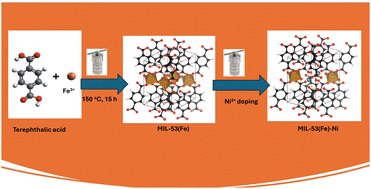
Metal–organic frameworks (MOFs) with dual metal sites are considered promising electrode materials for electrochemical energy storage applications owing to their unique structural and compositional advantages. Using a simple one-step solvothermal technique, nickel ions were incorporated into MIL-53(Fe) framework to design a nickel-doped iron-based MOF (MIL-53(Fe)-Ni), which was eventually used as an efficient electrode to improve supercapacitor performance. Owing to its distinct hexagonal pyramid-like structure and the synergistic effect of bimetallic ions, the MIL-53(Fe)-Ni-2 electrode material demonstrates a high specific capacity of 408.1 C g−1 at 1 A g−1 and remarkable cycling stability (80.9% capacity retention over 5000 cycles at 10 A g−1) in a half-cell system configuration. For practical applications, a full cell comprising a capacitive-type AC and a battery-type MIL-53(Fe)-Ni-2 was assembled to form an asymmetric supercapacitor device (ASC). The MIL-53(Fe)-Ni-2//AC ASC device resulted in a specific energy of 32.63 W h kg−1 at 1142 W kg−1 and capacity retention and coulombic efficiency of 72.5 and 99.3% respectively, which further led credence to the good stability of MIL-53(Fe)-Ni-2. This work provides insight into the effect of metal doping on modifying the properties of MOFs and demonstrating their great potential in supercapacitor research.
 Please wait while we load your content...


