


 PLATFORM UPDATE:


Ionic liquid–metal–organic framework-modified composite electrolyte for high-performing lithium-ion batteries†

Abstract
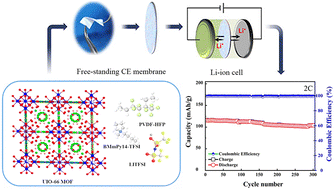
Solid polymer membranes are being widely explored as electrolytes for Li-ion batteries; however, the low ionic conductivity restricts their practical application. Developing high Li+ ion-conducting polymer electrolytes with superior thermal stability and mechanical strength has been a long-standing challenge. In this study, a composite electrolyte based on a metal–organic framework (MOF) and ionic liquids (ILs) incorporated with PVDF–HFP polymer (UIO@IL-CE) has been developed using a simple solution casting approach. The composite electrolyte (UIO@IL-CE) exhibits excellent thermal stability (400 °C) and mechanical strength. The electrochemical characterization shows that ionic conductivity is 6.14 × 10⁻⁴ S cm−1 at room temperature after the incorporation of MOF-IL, and it is further enhanced at elevated temperatures, i.e., 1.72 × 10⁻³ S cm−1 (75 °C). Furthermore, the cell with a composite electrolyte with a LiFePO4 cathode exhibits an initial discharge capacity of 140 mA h g−1 at 1C without fading the cycling performance. Remarkably, even at a high C-rate of 5C, the UIO@IL-CE-II membrane exhibits excellent electrochemical performance with a specific capacity of 81 mA h g−1 after 300 cycles, which is mainly attributed to the combination of MOF-IL and the PVDF–HFP matrix. The present study provides a new avenue and an effective strategy for developing high-performance lithium-ion batteries.
 Please wait while we load your content...


