


 PLATFORM UPDATE:

Influence of hydrophilic polymers on the accelerated blood clearance of mRNA lipid nanoparticles upon repeated administration
 abcf
Yi
Ju,
bde
Asuka
Takanashi,
a
Azizah
Algarni,
a
Chee Leng
Lee,
a
Stephen J.
Kent,
b
Colin W.
Pouton
a
and
Emily H.
Pilkington
*ab
abcf
Yi
Ju,
bde
Asuka
Takanashi,
a
Azizah
Algarni,
a
Chee Leng
Lee,
a
Stephen J.
Kent,
b
Colin W.
Pouton
a
and
Emily H.
Pilkington
*ab
Abstract
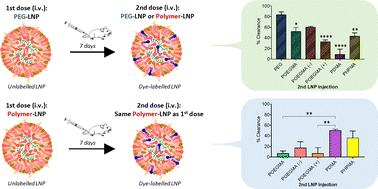
mRNA lipid nanoparticles (LNPs) have emerged as a leading delivery system for mRNA-based vaccines and therapeutics. However, a significant limitation of this system is the presence of poly(ethylene) glycol (PEG). It is widely known that repeated doses of PEG-based therapeutics can induce an anti-PEG antibody response, leading to the accelerated blood clearance (ABC) of LNP therapeutics requiring frequent dosing, as anti-PEG antibodies have been found present in a large proportion of the population. To address this issue, we developed a mouse model for LNP clearance after a repeated dose. We then synthesised LNPs with the PEG component replaced by a library of hydrophilic polymers: poly(oligo(ethylene glycol) methyl ether methacrylate) (POEGMA), POEGMA-methacrylic acid (POEGMA (−)), POEGMA-2-(dimethylamino)ethyl methacrylate (POEGMA (+)), poly(N,N-dimethylacrylamide) (PDMA), and poly(N-(2-hydroxypropyl) methacrylamide) (PHPMA). Our results demonstrated that all three POEGMA LNPs, especially POEGMA (+) LNPs, exhibited minimal ABC effect after two weekly doses; in contrast, PDMA LNPs demonstrated significantly lower clearance in the presence of anti-PEG antibodies. This study highlights the potential of PEG-free polymer–LNPs as promising mRNA carriers that avoid rapid clearance with repeated administration.
- This article is part of the themed collection: Celebrating International Women’s day 2026: Women in Nanoscience
 Please wait while we load your content...


