


 PLATFORM UPDATE:


Edge and defect effects on charge distribution in collapsed MoS2 nanotubes

Abstract
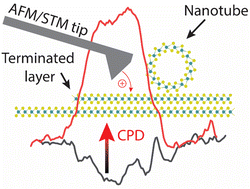
Molybdenum disulfide (MoS2) has emerged as a promising material for next-generation electronics and optoelectronic devices. MoS2 nanotubes (NTs) and their collapsed ribbon-like shapes (collapsed NTs) synthesized via chemical vapour transport (CVT) under chemical equilibrium typically exhibit low structural defect densities. However, defects and surface damage can arise during device fabrication or operation, leading to a significant degradation in performance, stability, and operational lifetime. These imperfections also induce hysteresis, which adversely affects the device switching behaviour. While the influence of charge trapping at the MoS2/substrate interfaces, on the MoS2 surface, and at intrinsic defects, such as sulfur vacancies and dangling bonds, on device performance has been extensively studied, MoS2 NTs, with their unique curved morphology, introduce additional charge-trapping mechanisms not observed in planar MoS2 structures. In this work, a combination of scanning tunnelling microscopy (STM), Kelvin probe force microscopy (KPFM), and conductive atomic force microscopy (c-AFM) was employed to examine how structural irregularities, including terminated layers, surface-grown flakes or NTs, and highly strained areas, affect charge injection, redistribution, and the resulting effects on electrical characteristics in collapsed NTs. The results reveal that structural defects act as charge traps, scattering centres, and transport barriers, giving rise to a reduced carrier mobility, localized charge accumulation, and spatially inhomogeneous charge distribution. These findings underscore the crucial role of structural and electrical characterization with nanoscale resolution in the design of defect-tolerant, high-performance devices based on transition metal dichalcogenides (TMDs).
 Please wait while we load your content...


