


 PLATFORM UPDATE:

Enhanced thermoelectric performance, inter-layer coupling effects and reduced lattice thermal conductivity in two-dimensional transition metal oxides

Abstract
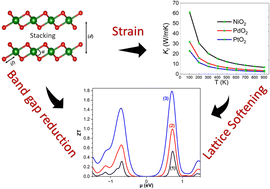
Two-dimensional metal oxides exhibit excellent waste heat recovery response, but still their efficiency requires improvement for commercial viability. Herein, a computational simulation is used to investigate the inter-layer coupling effect in AA-stacked NiO2, PdO2 and PtO2 bilayers and has provided evidence of their experimental feasibility by demonstrating negative binding energy and positive phonon modes. An approximately twofold increase in ZT of these bilayers is reported, compared to their monolayer counterparts. The first reason being narrowing of the electronic band gap (Eg = 1.18 eV, 1.57 eV, 1.79 eV) and a rise in electrical conductivity brought on by longer relaxation time of carriers, which contributes to the enhancement of power factor. Additionally, the presence of multiple minima/maxima of conduction/valence bands near the Fermi level simultaneously boosts electrical conductivity and the Seebeck coefficient. Second, the softening of phonon modes, which reduces phonon group velocity, and the presence of van der Waals interlayer interactions, collectively contribute to a notable decrease in lattice thermal conductivity. Moreover, high Grüneisen parameters of XO2 bilayers significantly influence their lattice thermal conductivity. At 700 K, the lattice thermal conductivity (κl) drops to 8.69 W m−1 K−1, 4.71 W m−1 K−1 and 1.93 W m−1 K−1, respectively, for NiO2, PdO2 and PtO2 bilayers, which is half of their monolayer counterparts. These effects collectively contribute to the improvement in ZT (1.05, 1.57, and 1.79, respectively). We anticipate that our observations will stimulate research on related low-dimensional materials for enhanced heat recovery performance.
 Please wait while we load your content...


