Issue 14, 2025

A mussel-like, biodegradable natural hydrogel can effectively prevent adhesion after cardiac surgery

Abstract

Postoperative cardiac tissue damage can lead to adhesions between the heart and surrounding tissues. These adhesions may result in restricted cardiac function, reduced quality of heart surgeries, and an increased risk of severe bleeding during reoperations. Therefore, it is essential to develop an effective anti-adhesion therapy to address postoperative cardiac adhesions. In this study, we propose a simple and easy-to-prepare adhesive hydrogel designed to prevent adhesions following cardiac surgery while maintaining normal cardiac pumping function. Dopamine was modified onto GelMA chains via a straightforward amidation reaction and mixed with silk fibroin to form a hydrogel (GelMA-DA/SF) under ultraviolet irradiation. In vitro experiments demonstrated that the GelMA-DA/SF hydrogel exhibited strong wet adhesion and could effectively degrade within 14 days. In vivo experiments showed that the GelMA-DA/SF hydrogel effectively prevented postoperative adhesions by reducing inflammation and friction. Therefore, the GelMA-DA/SF hydrogel is a reliable material for preventing postoperative adhesions and offers new insights and directions for subsequent therapeutic approaches.
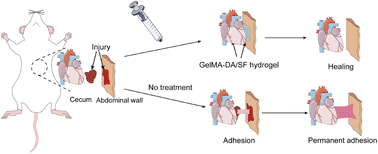
Graphical abstract: A mussel-like, biodegradable natural hydrogel can effectively prevent adhesion after cardiac surgery

Supplementary files

Article information

Article type
Paper
Submitted
01 Jan 2025
Accepted
13 Mar 2025
First published
09 Jun 2025
This article is Open Access
Creative Commons BY-NC license

Nanoscale Adv., 2025,7, 4425-4435

A mussel-like, biodegradable natural hydrogel can effectively prevent adhesion after cardiac surgery

J. Jiang, L. Chen, Y. Zhang and Y. Liu, Nanoscale Adv., 2025, 7, 4425 DOI: 10.1039/D5NA00005J

This article is licensed under a Creative Commons Attribution-NonCommercial 3.0 Unported Licence. You can use material from this article in other publications, without requesting further permission from the RSC, provided that the correct acknowledgement is given and it is not used for commercial purposes.

To request permission to reproduce material from this article in a commercial publication, please go to the Copyright Clearance Center request page.

If you are an author contributing to an RSC publication, you do not need to request permission provided correct acknowledgement is given.

If you are the author of this article, you do not need to request permission to reproduce figures and diagrams provided correct acknowledgement is given. If you want to reproduce the whole article in a third-party commercial publication (excluding your thesis/dissertation for which permission is not required) please go to the Copyright Clearance Center request page.

Read more about how to correctly acknowledge RSC content.

Social activity

Spotlight

Advertisements