Issue 24, 2025

Janus metal-enabled tunable Schottky barriers in van der Waals contacts via interfacial polarization modulations

Abstract

Two-dimensional semiconductors exhibit exceptional potential in next-generation electronics; however, the strong Fermi-level pinning effect in the metal–semiconductor (M–S) contacts inevitably generates an unmodulated Schottky barrier, severely compromising device performance. Here, to address this challenge, we propose a novel strategy using the polar metallic Janus TaSTe originating from the broken structure symmetry. Specifically, by switching the S or Te surface in contact with a semiconductor, tunable M–S interface interactions have been effectively achieved by the Janus TaSTe electrode, which is determined by interfacial polarization due to the difference in the electronegativity of S and Te atoms. In addition, we show that under the external electric fields and strain, the heights and types of the Schottky barrier of Janus TaSTe–PtS2 contact have been effectively tuned. We further demonstrate the universality of our strategy by expanding various M–S contacts between different Janus metals and semiconductors. Our results break through the limitation of work function and provide a novel way to tune the interfacial interactions between the metal and semiconductors, holding promising applications for future high-performance electronic devices.
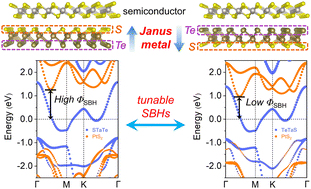
Graphical abstract: Janus metal-enabled tunable Schottky barriers in van der Waals contacts via interfacial polarization modulations

Supplementary files

Article information

Article type
Communication
Submitted
13 Aug 2025
Accepted
28 Oct 2025
First published
29 Oct 2025
This article is Open Access
Creative Commons BY-NC license

Mater. Horiz., 2025,12, 10630-10640

Janus metal-enabled tunable Schottky barriers in van der Waals contacts via interfacial polarization modulations

Y. Feng, L. Qi, Y. Du, N. Zhang, Y. Zou, Z. Shi, D. Li and S. Li, Mater. Horiz., 2025, 12, 10630 DOI: 10.1039/D5MH01553G

This article is licensed under a Creative Commons Attribution-NonCommercial 3.0 Unported Licence. You can use material from this article in other publications, without requesting further permission from the RSC, provided that the correct acknowledgement is given and it is not used for commercial purposes.

To request permission to reproduce material from this article in a commercial publication, please go to the Copyright Clearance Center request page.

If you are an author contributing to an RSC publication, you do not need to request permission provided correct acknowledgement is given.

If you are the author of this article, you do not need to request permission to reproduce figures and diagrams provided correct acknowledgement is given. If you want to reproduce the whole article in a third-party commercial publication (excluding your thesis/dissertation for which permission is not required) please go to the Copyright Clearance Center request page.

Read more about how to correctly acknowledge RSC content.

Social activity

Spotlight

Advertisements