


 PLATFORM UPDATE:


S-MGBs bearing amidine tail groups are potent, selective antiplasmodial agents†
 a
Colin J.
Suckling,
a
Rebecca
Beveridge,
a
Vicky M.
Avery
bc
and
Fraser J.
Scott
*a
a
Colin J.
Suckling,
a
Rebecca
Beveridge,
a
Vicky M.
Avery
bc
and
Fraser J.
Scott
*a
Abstract
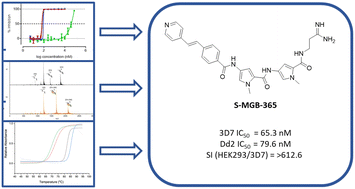
There were an estimated 249 million cases of malaria globally in 2022, causing approximately 608 000 deaths. Most of these are attributed to infection by P. falciparum. Strathclyde minor groove binders (S-MGBs) are a promising new class of anti-infective agent that have been shown to be effective against many infectious organisms, including P. falciparum. A panel of 25 S-MGBs was synthesised, including those bearing an amidine tail group, and their antiplasmodial activity against 3D7 and Dd2 strains was determined in vitro using an asexual P. falciparum imaging assay. Determination of activity against HEK293 cells allowed for selective cytotoxicity to be measured. DNA binding studies were carried out using native mass spectrometry and DNA thermal shift assays. A comparison of 3D7 (chloroquine sensitive) and Dd2 (chloroquine resistant) potency showed no evidence of cross-resistance across the S-MGB set. S-MGB-356, S-MGB-368 and S-MGB-359, amidine tail containing S-MGBs, were identified as the most promising hit compounds based on their selectivity indices (HEK293/3D7) of >612.6, >335.8 and >264.8, respectively. S-MGB-356, S-MGB-368 and S-MGB-359 were confirmed to bind to DNA as dimers, with gDNA thermal shifts (ΔTm) of 12 °C, 3 °C and 16 °C, respectively. Together, these data demonstrate that amidine tail bearing S-MGBs are promising hit compounds against P. falciparum, and can be further optimised into lead compounds.
- This article is part of the themed collection: Celebrating our 2025 Prizewinners
 Please wait while we load your content...


