


 PLATFORM UPDATE:


Cationic iridium(iii) complexes with a halogen-substituted pyridylbenzimidazole ancillary ligand for photodynamic therapy
 *a
Camille
Latouche,
bc
Louis
Biancon,
a
Ahmed S.
Faihan,
a
Jean-Luc
Coll,
d
Akos
Banyasz
e
and
Amandine
Hurbin
*d
*a
Camille
Latouche,
bc
Louis
Biancon,
a
Ahmed S.
Faihan,
a
Jean-Luc
Coll,
d
Akos
Banyasz
e
and
Amandine
Hurbin
*d
Abstract
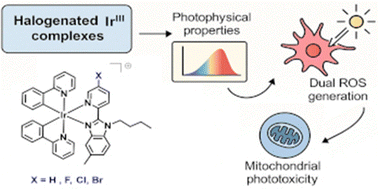
Photodynamic therapy (PDT) is a powerful technique, as the oxidative stress generated by light irradiation induces cell death through apoptosis and necrosis. In type II PDT, iridium(III) complexes exhibiting high singlet oxygen quantum yields are potent photosensitizers (PS). Their emission properties under aerated conditions also make them valuable theranostic agents for imaging-guided PDT against cancer. We report a series of four cationic Ir(III) complexes featuring a 2-pyridylbenzimidazole ancillary ligand substituted at the 5′ position of the pyridinyl ring with a halogen atom (F, Cl, or Br), along with a halogen-free reference compound. The absorption and emission spectra are efficiently tuned by the electron-withdrawing ability of the halogen atoms, allowing the emission energy of one complex to reach the tissue transparency window. Two-photon absorption (TPA) spectra have been measured, and all complexes display a TPA maximum around 700 nm. All compounds efficiently generate both singlet oxygen (1O2) and superoxide anion (O2˙−). Cellular studies have shown that the complexes are rapidly internalized into mitochondria, produce reactive oxygen species (1O2 and O2˙−), and exhibit high phototoxicity, with IC50 values as low as 59.9 nM under low light fluence (1.2 J cm−2). These results are supported by Time-Dependent Density Functional Theory (TD-DFT) simulations performed in both ground and excited states.
 Please wait while we load your content...


