


 PLATFORM UPDATE:


Simulation and machine learning driven optimization of Rb2SnBr6-based lead-free perovskite solar cells using diverse ETLs for enhanced photovoltaic performance
 *a
Asadul Islam
Shimul,
b
Aijaz Rasool
Chaudhry,
e
Dipongkar Ray
Sobuj,
f
Yedluri
Anil Kumar,
g
*a
Asadul Islam
Shimul,
b
Aijaz Rasool
Chaudhry,
e
Dipongkar Ray
Sobuj,
f
Yedluri
Anil Kumar,
g
Abstract
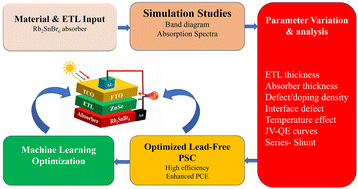
In this work, n–i–p planar heterojunction perovskite solar cells (PSCs) were simulated using SCAPS-1D, employing Rb2SnBr6 as a lead-free, stable, and cost-effective absorber. Fluorine-doped tin oxide (FTO) served as the transparent substrate, with gold (Au) as the rear contact, and three electron transport layers (ETLs) – ZnSe, In2S3, and CdZnSe – were evaluated. Device I (ZnSe) achieved the best performance with a PCE of 28.73%, VOC of 0.868 V, JSC of 38.09 mA cm−2, and FF of 86.86%. Device II (In2S3) and device III (CdZnSe) exhibited lower efficiencies of 26.62% and 24.04%, respectively. To further analyze performance, a random forest (RF) machine learning model was applied, with SHAP values identifying the most influential parameters. The RF model demonstrated high accuracy (R2 = 0.8825) and strong agreement between predicted and actual efficiencies. These results highlight the potential of Rb2SnBr6, particularly with a ZnSe ETL, for developing high-efficiency, eco-friendly PSCs.
 Please wait while we load your content...


