


 PLATFORM UPDATE:


Experimental optical analysis and DFT study of the electronic, thermoelectric and optical characteristics of a co-doped perovskite system

Abstract
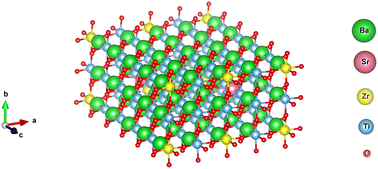
Experimental and theoretical investigations of the electronic, thermoelectric and optical properties of Ba0.85Sr0.15Ti0.85Zr0.15O3 ceramic are presented via density functional theory (DFT) calculations performed using the generalized gradient approximation (GGA) with a plane-wave pseudopotential approach. This interesting combined analysis provides valuable insights into the potential of the material for advanced functional applications. The electronic structure analysis reveals that Ba0.85Sr0.15Ti0.85Zr0.15O3 exhibits a semiconducting behavior with a band gap energy of approximately 2.52 eV. The partial density of states analysis reveals that the O “p” orbitals dominate the valence band, while the Ti and Zr “d” orbitals primarily contribute to the conduction band. The thermoelectric properties examined between 300–1200 K show a consistently positive Seebeck coefficient, confirming p-type conduction. The material also demonstrates a notable dimensionless figure of merit at 300 K, indicating excellent thermoelectric performance near room temperature. These features suggest that Ba0.85Sr0.15Ti0.85Zr0.15O3 is a promising candidate for ambient-temperature thermoelectric energy conversion, optoelectronic devices, and multifunctional oxide-based electronics. Experimentally, UV-visible spectroscopy yielded a direct band gap of 2.419 eV and an Urbach energy of 0.784 eV, reflecting a moderate level of localized states within the band gap. The extinction coefficient spectrum reveals pronounced wavelength-dependent features, with enhanced absorption extending from the UV to the visible-red region (650–720 nm), indicating the formation of defect-related and polaronic states that effectively narrow the optical band gap.
 Please wait while we load your content...


