


 PLATFORM UPDATE:


Enzyme-containing double layer polymersomes coated by erythrocytes as a biomimetic nanoscavengers for in vivo protection from toxicants†
 *ab
Dmitry
Tatarinov,
b
*ab
Dmitry
Tatarinov,
b
Abstract
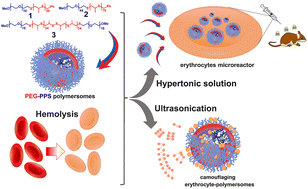
A new strategy for effective antidotes against organophosphorus compounds (OPs) is enzyme-loaded nanoscavenger technology. Cell membrane-coated nanoforms of bioscavengers reduce adverse effects and ensure stability, immunotolerance, and prolonged protective action. For the first time, synthesis of double layers polymersomes coated by red blood cells (erythrocytes) ghosts, based on amphiphilic di- and triblock polyethylene glycol–polysulfide copolymers (PEG-b-PPS) was carried out to make enzyme microreactors. The enzyme was an evolved multiple mutant of the archaea Saccharolobus solfataricus phosphotriesterase (PTE). Two approaches were used for making this formulation: lipid fusion and hypotonic swelling. Respectively two types of PTE-loaded nanoscavengers (i) hybrid camouflaging RBC–PTE–loaded polymersomes and (ii) PTE–polymersomes captured by erythrocytes ghosts (PTE–RBC–microreactors) were prepared with high encapsulation efficiency, loading capacity and enzyme activity. CD-1 mice were challenged with paraoxon as a model OP. Pre-treatment of animals with i.v. injected PTE–RBC–microreactors led to LD50 shifts up to 15.5 times compared to control mice. In post-exposure treatments, LD50 shifts were up to 9.8 times. Pharmacokinetics of PTE–RBC–microreactors showed half times of 20 min and 1 hour for distribution and elimination phases, respectively. These first results with erythrocyte ghost microreactors are promising and open a new way to personalized medical countermeasures for detoxification of OPs and other toxicants.
 Please wait while we load your content...


