


 PLATFORM UPDATE:


Comparative analysis of monomeric vs. dimeric salen fluorescent probes: transition from a turn-on to ratiometric response towards nerve gas agents in organic to aqueous media†
 *a
*a
Abstract
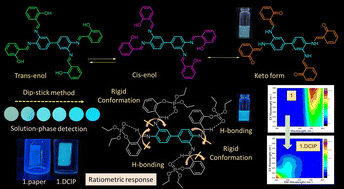
Nerve agents are among the most hazardous chemical warfare agents, requiring easy detection and prompt remediation. To this end, we synthesized two fluorescent salen molecules, P-1 (dimeric) and P-2 (monomeric), for the detection of diethyl chlorophosphate (DClP), a mimic of sarin and soman, in an aqueous medium. P-1 exhibited a stronger fluorescence response (∼22.0-fold) towards DClP than P-2 (∼1.1-fold). This superior performance of P-1 could be attributed to its dimeric structure, difference in aggregation, and photophysical properties. The mechanistic studies revealed that DClP-mediated phosphorylation of the hydroxy groups led to changes in the keto–enol equilibrium and aggregation state of compound P-1. Unlike in an aqueous medium, P-1 in DMSO medium displayed a turn-on fluorescence response towards DClP. The minimum detectable limit for DClP resulted in ∼5.0 ppb in an aqueous medium. P-1 was also effective in detecting DClP in soil samples, with a detection limit of ∼15.0 ppb, a recovery of 95.4–97.8%, and a relative standard deviation (RSD) within 2–3%, demonstrating the reliability and robustness of the present method. Finally, chemically modified dye coated paper strips were developed for rapid and on site detection of release of nerve gas vapour beyond permissible limit.
 Please wait while we load your content...


