Issue 1, 2025

Green synthesis and physicochemical characterization of an eco-friendly zero-valent iron biochar based on Coula edulis shell and morinda bark extracts using response surface analysis

Abstract

In the present study, two biochars obtained from waste agricultural residue were chemically activated with H2SO4 (HN/AC) and impregnated with zero-valent iron using morinda stem bark extract as a reducing agent (HN/AC/Fe°). The central composite design (CCD) of response surface methodology with three replicated centre points was used to optimize the operating conditions for the production of both biochars. The precursor and the prepared biochars were characterized via FTIR, TGA, SEM, BET and XRD analyses, and their efficiency was tested for the elimination of malachite green. The optimum synthesis conditions for HN/AC (1 N sulphuric acid, 10 g Coula edulis and 30 min) and HN/AC/Fe° (0.075 M iron concentration, 6 g morinda and 60 min) permitted us to obtain specific surface areas of 178.136 and 361.70 m2 g−1, respectively. The biochar HN/AC/Fe° presented a microstructure, which was more amorphous and more porous than HN/AC. HN/AC/Fe° demonstrated an elimination rate of 97.08% for malachite green. These results show that response surface methodology is an outstanding and useful tool for the optimal synthesis of biochar engineered using zero-valent iron and morinda stem bark extract.
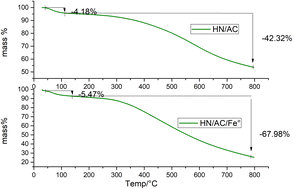
Graphical abstract: Green synthesis and physicochemical characterization of an eco-friendly zero-valent iron biochar based on Coula edulis shell and morinda bark extracts using response surface analysis

Transparent peer review

To support increased transparency, we offer authors the option to publish the peer review history alongside their article.

View this article’s peer review history

Article information

Article type
Paper
Submitted
14 Jul 2024
Accepted
11 Aug 2024
First published
20 Aug 2024
This article is Open Access
Creative Commons BY-NC license

Mater. Adv., 2025,6, 184-195

Green synthesis and physicochemical characterization of an eco-friendly zero-valent iron biochar based on Coula edulis shell and morinda bark extracts using response surface analysis

C. A. N. Simo, J. M. Dika and C. M. Kede, Mater. Adv., 2025, 6, 184 DOI: 10.1039/D4MA00714J

This article is licensed under a Creative Commons Attribution-NonCommercial 3.0 Unported Licence. You can use material from this article in other publications, without requesting further permission from the RSC, provided that the correct acknowledgement is given and it is not used for commercial purposes.

To request permission to reproduce material from this article in a commercial publication, please go to the Copyright Clearance Center request page.

If you are an author contributing to an RSC publication, you do not need to request permission provided correct acknowledgement is given.

If you are the author of this article, you do not need to request permission to reproduce figures and diagrams provided correct acknowledgement is given. If you want to reproduce the whole article in a third-party commercial publication (excluding your thesis/dissertation for which permission is not required) please go to the Copyright Clearance Center request page.

Read more about how to correctly acknowledge RSC content.

Social activity

Spotlight

Advertisements