


 PLATFORM UPDATE:

Dual modification of LiNbO3 and a lithium-conducting organic polymer at LiCoO2/Li10GeP2S12 interface and lithium intercalation properties in all-solid-state lithium-ion batteries
 a
Steven W.
Thompson,
d
Thiago R.
Guimarães,
e
Ryoji
Kanno,
c
Per B.
Zetterlund
*d
and
Masaaki
Hirayama
*ac
a
Steven W.
Thompson,
d
Thiago R.
Guimarães,
e
Ryoji
Kanno,
c
Per B.
Zetterlund
*d
and
Masaaki
Hirayama
*ac
Abstract
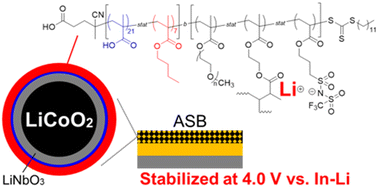
A lithium-conducting organic copolymer mainly comprising the comonomers poly(ethylene glycol) methyl ether methacrylate and lithium 3-[(trifluoromethane)sulfonamidosulfonyl]propyl methacrylate (LiMTFSI) (referred to as “Li-polymer”) was coated on LiNbO3-modified LiCoO2 particles. The in situ polymerization was conducted via reversible addition–fragmentation chain transfer (RAFT) assisted encapsulating polymerisation (REEP) to form the Li-polymer coating, aiming to enhance the electrochemical stability of cathode-sulfide electrolyte interfaces in all-solid-state lithium-ion batteries. The formation of a thin Li-polymer layer on the LiNbO3/LiCoO2 surface was confirmed through X-ray diffraction, scanning electron microscopy with energy-dispersive X-ray spectroscopy, and thermogravimetric analysis. These analyses indicated no structural changes of LiNbO3-modified LiCoO2 during the modification process with Li-polymer. Galvanostatic charge–discharge and electrochemical impedance spectroscopy analyses revealed that, among the Li-polymer/LiNbO3/LiCoO2–Li10GeP2S12 composite cathodes, the composite incorporating a Li-polymer containing 50% LiMTFSI, with a higher lithium content and low glass-forming tendency, demonstrated the highest electrochemical activity. However, even with 50% LiMTFSI-containing Li-polymer, the capacity remained lower than that of LiNbO3/LiCoO2–Li10GeP2S12. On the other hand, under high-voltage charging, the Li-polymer–coated composite demonstrated improved capacity retention compared to the Li-polymer–uncoated composite. These findings highlight the potential of organic polymer modification layers to enhance the interfacial stability of high-voltage all-solid-state lithium-ion batteries (ASBs) with sulfide solid electrolytes.
 Please wait while we load your content...


