


 PLATFORM UPDATE:


Establishment of an ultrasound-responsive microfluidic chip BBB-glioblastoma model for studying sonodynamic therapy-enhanced nanodrug delivery
 *abd
and
Yihong
Li
*abc
*abd
and
Yihong
Li
*abc
Abstract
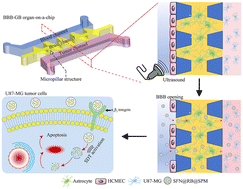
Glioblastoma (GB), the most common primary malignant brain tumor, is challenging to treat because the blood–brain-barrier (BBB) limits effective drug delivery. Sonodynamic therapy (SDT) presents a promising non-invasive alternative, using ultrasound for deep tissue penetration to transiently open the BBB and activate sonosensitizers for localized GB destruction. However, mechanistic understanding and optimization of SDT are hindered by the lack of integrated platforms capable of quantitatively elucidating the relationships between ultrasound-controlled BBB dynamics, drug delivery kinetics, and SDT efficacy. To address this, we developed a physiologically relevant BBB-GB organ-on-a-chip model integrating human cerebral microvascular endothelial cells (HCMECs), primary astrocytes (ACs), and U87-MG cells within a Matrigel-embedded microfluidic chip. This model recapitulated key BBB features, confirmed by continuous ZO-1 tight junction expression and size-selective permeability (FITC-dextran assay). Crucially, the ultrasound-opened barrier retained selective permeability, favoring nanocarriers like our tumor-targeting SFN@RB@SPM nanomicelles while effectively excluding free small molecules (rose bengal) and other nanoparticle types (Exo-RB), thereby mimicking the discriminative function of the biological BBB. Low-intensity ultrasound (1 MHz, 1 W cm−2, 30 s) induced transient, reversible BBB opening, with full functional and structural recovery within 24 h. Utilizing this controlled opening, our self-assembled tumor-targeting nanomicelles (SFN@RB@SPM) exhibited significantly enhanced BBB permeability. Real-time monitoring revealed efficient, selective uptake of SFN@RB@SPM by U87-MG cells. Sequential ultrasound application—first to open the BBB for nanomicelle delivery and second to activate SDT—synergistically amplified intracellular reactive oxygen species (ROS) generation and induced near-complete U87-MG cell death. These effects were unachievable with either ultrasound or nanomicelles alone. This integrated BBB-GB organ-on-a-chip platform enables simultaneous quantification of ultrasound-regulated BBB permeability, multicellular interactions, tumor-targeted nanodrug delivery dynamics, and SDT therapeutic efficacy. It thus provides a powerful in vitro tool for elucidating SDT mechanisms and accelerating the development of novel glioma therapies.
 Please wait while we load your content...


