


 PLATFORM UPDATE:


Design, fabrication, and characterization of a microbubble array microphysiological system

Abstract
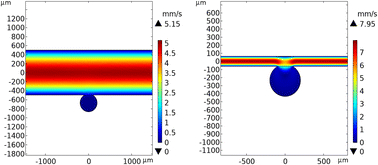
Microbubble (MB) technology is uniquely suited for integration into microphysiological systems (MPS) for high throughput three-dimensional (3D) tissue culture, drug screening and toxicity testing. MBs are spherical compartments with nanoliter volumes produced in an array format. Here, we present a novel hybrid MB-fluidic MPS that combines 3D tissue culture with controlled fluid flow to improve nutrient delivery, waste removal, and physiological relevance. Computational fluid dynamics (CFD) simulations were used to model velocity and solute diffusion profiles as a function of MB aspect ratio (AR), with validation by fluorescent polystyrene microsphere optical tracking. Simulations reveal pronounced velocity decoupling and shear dampening effects with intra-MB flow velocities over 200-fold lower than the main channel—allowing high channel flow rates for efficient exchange while preserving low-shear microenvironments, optimal for tissue culture. Additionally, tissues spatially compartmentalized in individual MBs are not dislodged under high flow conditions. This allowance for high channel flow rates, decoupled from the MB microenvironment, enables the use of millifluidic devices which are less difficult to manufacture and control than microfluidic devices. Simulations also showed that MBs with AR values between 2 and 3 offered a balance between nutrient transport and retention of cell-secreted factors. In contrast, rectilinear wells exhibited flow splitting and lactate accumulation at AR > 2, highlighting a key advantage of the spherical MB geometry. We fabricated a millifluidic MB device using fused deposition modeling (FDM) 3D printing and a novel molding strategy to create optically clear, leak-free flow channels. Murine salivary gland tissues cultured under flow in this device showed preserved acinar cell marker gene expression and reduced ductal markers, supporting the hypothesis that dynamic flow enhances tissue fidelity. This MB-fluidic platform enables scalable, high-content 3D culture systems suitable for organoid, tumor spheroid, and tissue mimetic applications in drug discovery and toxicology.
 Please wait while we load your content...


