


 PLATFORM UPDATE:

High sensitive detection of arsenic and selenium using a portable hydride generation-atmospheric pressure glow discharge atomic emission spectrometer

Abstract
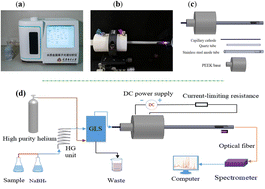
Selenium (Se) and arsenic (As) are essential or toxic trace elements that require sensitive on-site monitoring. However, conventional atomic spectrometric techniques such as inductively coupled plasma atomic emission spectrometry (ICP-AES) are restricted to laboratory use due to high power consumption and bulky infrastructure. This study developed a field-deployable analytical system by integrating a self-designed, lithium-ion battery-powered microplasma excitation source with an optimized hydride generation module, resulting in a miniaturized atmospheric pressure glow discharge atomic emission spectrometer (HG–APGD-AES). The instrument achieves laboratory-grade analytical sensitivity under ultra-low resource consumption conditions. Under optimized conditions for the HG system and APGD excitation system, detection limits of 0.24 μg L−1 for As and 0.36 μg L−1 for Se were achieved, with excellent linearity (R2 > 0.998) and precision (<1.5% RSD, n = 10). The spectrometer's performance was validated using certified reference materials (BWB2261-2016, BWB2007-2016F) and natural water samples from the Yangtze River, Tushan Lake, and Binan River. Results demonstrate high accuracy, stability, and analytical efficiency, supporting the spectrometer's suitability for on-site environmental monitoring of Se and As.
 Please wait while we load your content...


