


 PLATFORM UPDATE:


Single particle ICP-TOFMS for the detection of micro-scale polystyrene and polyvinyl chloride from artificially aged bulk plastic

Abstract
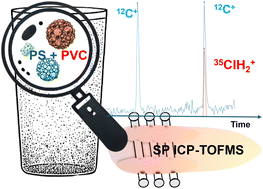
A method for the simultaneous analysis of carbon (C) and chlorine (Cl) in individual microplastic particles (MPs) using single particle (SP) inductively coupled plasma – time-of-flight mass spectrometry (ICP-TOFMS) was developed. The approach exploited hydrogen-assisted cluster ion formation to monitor Cl as 35ClH2+ and was applied in conjunction with a collision/reaction cell that used an altered radiofrequency amplitude to balance ion transmission for both C+ and ClH2+. This strategy improved detection limits for Cl-bearing particles and enabled co-detection of C and Cl within the same SP event. As a proof of concept, artificially aged polystyrene (PS) and polyvinyl chloride (PVC) were analysed. Discrimination of MP polymers was achieved by detecting either only C in a SP event (PS) or the coincident detection of C and Cl (PVC). Critical detection thresholds of 1.2 μm (0.8 pg, via C) for PS and 1.4 μm (0.8 pg, via C) or 1.3 μm (0.9 pg, via Cl) for PVC were determined. Particles larger than ∼10 μm, however, were poorly transported by the nebulisation system, limiting effective detection to smaller MPs.
- This article is part of the themed collection: Winter Conference on Plasma Spectrochemistry
 Please wait while we load your content...


