


 PLATFORM UPDATE:


Precision and accuracy of highly-enriched double-spike Fe taggant measurements using quadrupole- and multicollector-ICP-MS
 ab
Christopher R.
Barrett,
a
Kyle M.
Samperton,
*ab
Katherine
Koh
*a
and
Gage B.
Green
*a
ab
Christopher R.
Barrett,
a
Kyle M.
Samperton,
*ab
Katherine
Koh
*a
and
Gage B.
Green
*a
Abstract
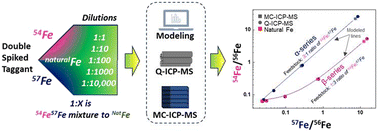
Management of material throughout the nuclear fuel cycle is critical in maintaining global nuclear security. Incorporating “double spiked” isotopic taggants into nuclear fuel is one method by which unique chemical signatures can be assigned to fuel components for later characterization and identification if material is found outside of regulatory control. While these taggants are characterized to the highest precision using multicollection inductively coupled mass spectrometer (MC-ICP-MS), the significant laboratory and personnel requirements to maintain multicollection instruments restricts their global use. In contrast, single collection ICP-MS are widely available and found in nearly every academic and national lab institution. This work explores if quadrupole-focused single collector ICP-MS can adequately characterize nuclear fuel isotopic taggants through a comparison with a MC-ICP-MS and modeled theoretically achievable precision. This comparison was enabled by producing enriched iron (Fe) isotope taggant endmembers (54Fe and 57Fe), which were then diluted with natural Fe to create a series of taggant solutions, with Fe isotopic compositions ranging from highly enriched to near-natural. These solutions were isotopically characterized using both MC-ICP-MS and quadrupole ICP-MS (Q-ICP-MS) equipped with a helium collision cell to investigate the precision and accuracy limits of these instruments in resolving taggant material from natural Fe. Precision on both instruments was lower than modeled theoretical (Poisson) precision, likely due to the combined effects of unresolved isobaric interferences impacting the Fe isotopic spectra and intrinsic plasma ion source noise. Both instruments are capable of resolving the taggant signature at a 1000× dilution with natural Fe, while only δ57 perturbations could be resolved outside of uncertainty for the 10 000× dilutions. These results demonstrate that the more widely accessible Q-ICP-MS platform can be used to characterize taggants up to the 1000× dilution level. This capability will allow for dozens of unique isotopic “barcodes” to be synthesized and detected using commercially available, relatively affordable mass spectrometric instrumentation, and underscores the potential of modern Q-ICP-MS platforms in being able to quantify subtle isotopic differences in challenging material formulations.
 Please wait while we load your content...


