


 PLATFORM UPDATE:


An electrolyte additive enabling dual kinetic regulation for stable zinc anodes in aqueous zinc batteries

Abstract
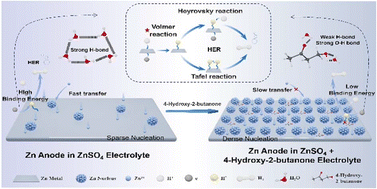
The practical deployment of aqueous zinc batteries (AZBs) is impeded by the hydrogen evolution reaction (HER) and uncontrolled dendrite formation on the zinc anode. This study proposes a green electrolyte-engineering strategy utilizing the biodegradable molecule 4-hydroxy-2-butanone (HB) as an electrolyte additive to achieve dual kinetic regulation. Integrated experimental characterization and theoretical simulations demonstrate that HB molecules preferentially adsorb onto the zinc anode surface. This adsorption simultaneously attenuates the adsorption energy of proton intermediates (H*), thereby substantially suppressing the HER, and modulates zinc deposition kinetics through delaying Sand's time and accelerating nucleation rates. Consequently, the synergistic effect yields compact and dendrite-free zinc deposition layers. Owing to the effective suppression of interfacial side reactions and the optimized deposition morphology, the Zn||Cu cell employing the HB electrolyte exhibits a significantly enhanced average coulombic efficiency. Concomitantly, both the Zn||Zn symmetric cell and the Zn||MnO2 full cell demonstrate markedly superior long-term cycling stability compared to the conventional ZnSO4 electrolyte system. This work reveals the dual regulatory mechanism of a green additive and proposes an environmentally benign electrolyte design for high-performance, sustainable aqueous zinc batteries.
 Please wait while we load your content...


