


 PLATFORM UPDATE:


A visible-light-mediated decarboxylative umpolung strategy to access carbamoyl/acyl fluorides in a buffer medium: expedient access to unsymmetrical ureas/amides and lysine-selective bioconjugation
 *ab
*ab
Abstract
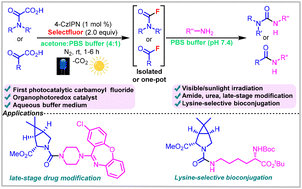
Acyl halides, particularly acyl chlorides, are indispensable yet highly reactive electrophiles that hydrolyze spontaneously in water or even with aerial moisture. Owing to their distinct reactivities, particularly stability in aqueous media, carbamoyl and acyl fluorides are emerging as user- and environmentally friendly alternatives to their chloride counterparts. For the first time, we have disclosed a photocatalytic decarboxylative fluorination of oxamic acids and α-ketoacids to the corresponding carbamoyl and acyl fluorides in an aqueous medium. Remarkably, this decarboxylative fluorination reaction proceeds smoothly with an inexpensive, electrophilic, green fluorinating agent, Selectfluor ($2 per g), using an organophotoredox catalyst, 4-CzIPN, under visible light irradiation, furnishing carbamoyl/acyl fluorides in high yields. Subsequently, they were trapped with amines for an expedient access to unsymmetrical ureas and amides either in situ or separately in a PBS buffer medium (pH ∼7.4) without any external base. Furthermore, amino acid modification and late-stage modification of drug candidates were performed under these mild conditions. This metal-free, ambient, and aqueous-medium reaction also proceeds smoothly under renewable sunlight irradiation. Intrigued by the application of urea/amide coupling under biocompatible conditions, we realized neutral PBS buffer-mediated mild urea formation at room temperature, which has potential for the development of an in situ click reaction. Gratifyingly, we have demonstrated that carbamoyl fluoride has an inherent preference towards urea formation with amines in the presence of other nucleophiles in a buffer medium at physiological pH, which exhibits better chemoselectivity than sulfur fluoride exchange (SuFEx) click chemistry. Finally, we have demonstrated a lysine-selective urea conjugation with carbamoyl fluoride in the presence of serine or cysteine via competitive experiments (Scheme 5b, 5c) and on a Nonapeptide-1 (Scheme 6). From control experiments, photophysical studies, and HOMO–LUMO calculations, the involvement of a radical pathway for the carbamoyl fluoride formation has been elucidated.
 Please wait while we load your content...


