


 PLATFORM UPDATE:

Phosphate ester-based organocatalyst with strong electron-withdrawing substituents for efficient chemical recycling of poly(lactic acid)
 a
and
Lin
Yu
*a
a
and
Lin
Yu
*a
Abstract
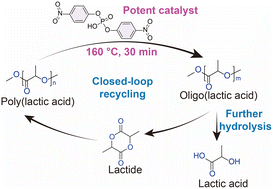
Poly(lactic acid) (PLA), a bioplastic currently with the highest production capacity, represents a promising alternative to traditional petroleum-based plastics. However, its slow degradation in natural environments and limited recycling options restrict its large-scale application. We recently discovered that diphenyl phosphate (DPP) can serve as a catalyst for PLA hydrolysis. Herein, to screen a more potent catalyst for PLA hydrolysis, various DPP derivatives are synthesized. We reveal that the catalytic degradation of PLA follows a dual activation mechanism, and the catalytic activity of these derivatives correlates positively with the electron deficiency of aromatic substituents. p-Bis-nitrophenyl phosphate (p-BNPP) with the strongest electron-withdrawing groups demonstrates the highest catalytic performance for PLA hydrolysis reported to date. Using just 3.5 wt% p-BNPP and a small amount of water, commercial PLA pellets/products are efficiently hydrolyzed into oligo(lactic acid) (OLA) with the average degree of polymerization below 4 within 30 min at 160 °C, without external pressure or organic solvents. p-BNPP can be reused at least 10 times and works well for other biodegradable polyester/polycarbonate hydrolysis. The resulting OLA can either be repurposed for producing high-quality PLA or transformed into a concentrated lactic acid solution. Additionally, this recycling flowsheet is successfully implemented in a kilogram-scale batch reactor.
 Please wait while we load your content...


