Issue 44, 2025

Efficient catalytic depolymerization of high-molecular-weight PMMA under low-temperature and high-concentration conditions

Abstract

To help alleviate resource waste and environmental pollution from discarded poly(methyl methacrylate) (PMMA), we demonstrate facile synthesis and efficient catalytic depolymerization of high-molecular-weight PMMA. A small fraction of C–Me bonds are replaced with catalytically activatable C–Cl bonds via free radical copolymerization of MMA with readily available methyl α-chloroacrylate. Leveraging low-temperature efficient catalysis by Cu(0), the synthesized polymers achieve high recyclability while maintaining ideal intrinsic properties. For PMMA with Mn exceeding 300 kg mol−1 (380–1010 kg mol−1), Cu(0)-catalyzed depolymerizations attain the highest reported depolymerization efficiency (∼90% in 4 hours) at a temperature well below 200 °C (160 °C) and high concentrations ([MMA unit]0 = 400–8800 mM). The recovered MMA monomer can be effectively repolymerized into a polymer with molecular weight and properties comparable to those of the polymer synthesized from a virgin monomer, and both catalysts and solvents used in this approach exhibit potential for recyclability.
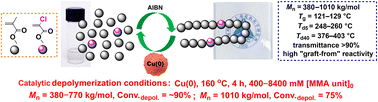
Graphical abstract: Efficient catalytic depolymerization of high-molecular-weight PMMA under low-temperature and high-concentration conditions

Supplementary files

Transparent peer review

To support increased transparency, we offer authors the option to publish the peer review history alongside their article.

View this article’s peer review history

Article information

Article type
Paper
Submitted
08 Aug 2025
Accepted
14 Oct 2025
First published
15 Oct 2025
This article is Open Access
Creative Commons BY-NC license

Green Chem., 2025,27, 14350-14358

Efficient catalytic depolymerization of high-molecular-weight PMMA under low-temperature and high-concentration conditions

Y. Ma, X. Yang, H. Shi, J. Li, X. Wang and Y. Tang, Green Chem., 2025, 27, 14350 DOI: 10.1039/D5GC04143K

This article is licensed under a Creative Commons Attribution-NonCommercial 3.0 Unported Licence. You can use material from this article in other publications, without requesting further permission from the RSC, provided that the correct acknowledgement is given and it is not used for commercial purposes.

To request permission to reproduce material from this article in a commercial publication, please go to the Copyright Clearance Center request page.

If you are an author contributing to an RSC publication, you do not need to request permission provided correct acknowledgement is given.

If you are the author of this article, you do not need to request permission to reproduce figures and diagrams provided correct acknowledgement is given. If you want to reproduce the whole article in a third-party commercial publication (excluding your thesis/dissertation for which permission is not required) please go to the Copyright Clearance Center request page.

Read more about how to correctly acknowledge RSC content.

Social activity

Spotlight

Advertisements