


 PLATFORM UPDATE:


Enhanced nitrogen fixation using DBD plasma with continuous flowing water and a TiO2 photocatalyst coupled system

Abstract
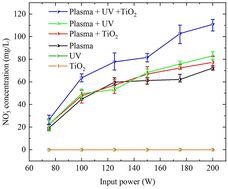
In this study, a novel dielectric barrier discharge (DBD) with continuous flowing water is designed (other devices commonly utilize immobile water), which could be easily coupled with UV light and TiO2 to achieve highly efficient nitrogen fixation (NF) from air plasma over water surface. Electrical characterization, optical emission spectroscopy and X-ray photoelectron spectroscopy (XPS) are performed to study the plasma properties and underlying mechanisms of NF under different conditions. Results indicate that the maximum nitrate concentration and minimum energy consumption can reach 154 mg L−1 and 61 MJ mol−1, respectively, in the case of pure plasma. The total amount of dissolved nitrogen (TN) reaches a maximum concentration of 199 mg L−1, indicating that the main nitrogen fixation product is nitrate, while the nitrite concentration is very low. By coupling TiO2 spheres in the water and UV light, the concentration of nitrate and TN increases by 57% and 45%, respectively, compared with the pure plasma condition at an input power of 200 W and a processing time of 20 min. XPS analysis directly demonstrates a change in the Ti valence state on the TiO2 surface, indicating the formation of more electron–hole pairs. Thus, more highly oxidizing species are formed on the photocatalyst surface to enhance the production of NOx. A mechanism is proposed that describes the underlying chemistry in the gas and liquid phases and the enhanced NF efficiency upon the addition of TiO2 spheres and UV light irradiation. As the use of the circulating water as the ground electrode can lead to thermal quenching, the novel DBD NF device can realize continuous operation time at a relatively high power, offering good application prospect.
- This article is part of the themed collection: 2025 Green Chemistry Covers
 Please wait while we load your content...


