


 PLATFORM UPDATE:


Flavonoids from Rosa roxburghii Tratt fermentation broth inhibit adipogenesis via the SIRT1 pathway: insights from metabolomics and network pharmacology
 †ac
Youjing
Ruan,
†b
†ac
Youjing
Ruan,
†b
Abstract
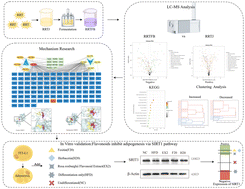
This study explored the metabolic shifts in Rosa roxburghii Tratt juice (RRTJ) following fermentation and assessed its impact on adipocyte differentiation. Non-targeted metabolomics revealed significant changes, particularly in flavor-related compounds and flavonoid profiles, with KEGG enrichment analysis highlighting energy metabolism and secondary metabolic pathways. Cluster analysis categorized differentially expressed metabolites into flavor-forming and anti-inflammatory/antioxidant groups. Quantitatively, RRT extract had a flavonoid content of 7.64% (0.764 mg mL−1), while RRTJ and Rosa roxburghii Tratt fermentation broth (RRTFB) contained 1.31% and 1.13% flavonoids, respectively. Network pharmacology identified nine key anti-inflammatory/antioxidant compounds, four of which were flavonoids, with molecular docking confirming strong binding affinities to SIRT1. In vitro experiments using 3T3-L1 cells demonstrated that RRT-derived flavonoids inhibited adipocyte differentiation by regulating SIRT1 expression. RRT-derived flavonoids exert anti-adipogenic effects via SIRT1 pathway activation, offering insights into its functional properties and processing applications.
 Please wait while we load your content...


