


 PLATFORM UPDATE:

Comparative evaluation and optimization of microwave and ultrasound assisted extraction of stevia secondary bioactive compounds using RSM and ANN–GA approaches

Abstract
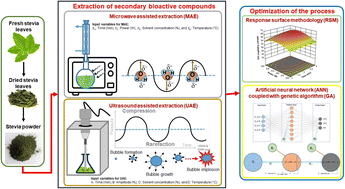
The increasing demand for functional foods enriched with bioactive compounds has encouraged the exploration of advanced extraction techniques. Stevia rebaudiana, a natural herb rich in bioactive compounds with antioxidant, anti-inflammatory, and anti-diabetic properties, shows considerable potential for functional food applications. This study optimized microwave assisted extraction (MAE) and ultrasound assisted extraction (UAE) to maximize the recovery of stevia's secondary bioactive metabolites. Single-factor analysis revealed that a 50% ethanol concentration at 50 °C significantly (p < 0.05) increased the phenolic content by 33.06% compared to water as a solvent. Second-order quadratic models developed using response surface methodology (RSM) showed strong statistical significance (p < 0.0001) and high adjusted R2 values, ranging from 0.8893–0.9533 for MAE and 0.9177–0.9326 for UAE, confirming model reliability. Comparative experimental design analysis indicated that MAE outperformed UAE, yielding 8.07%, 11.34%, and 5.82% higher total phenolic content (TPC), total flavonoid content (TFC), and antioxidant activity (AA), respectively, with 58.33% less extraction time. Artificial neural networks coupled with genetic algorithm (ANN–GA) models further improved predictive accuracy, with the MAE model achieving an R2 of 0.9985 and a mean squared error (MSE) of 0.7029, outperforming the UAE model (R2 of 0.9981 and MSE of 0.8362). The ANN–GA predicted optimized MAE conditions of 5.15 min extraction time, 284.05 W microwave power, 53.10% ethanol concentration, and 53.89 °C temperature, yielded higher TPC, TFC, and AA values with minimal error. These results established MAE as a more efficient, sustainable, and effective method for extracting bioactive compounds from stevia leaves compared to UAE.
 Please wait while we load your content...


