


 PLATFORM UPDATE:

Valorization of legume by-products in functional formulations: phytochemicals and their simulated gastrointestinal fate
 a
Mustafa Tahsin
Yilmaz,
b
Elwira
Sieniawska,
c
Benita
Hryć,
c
Mehmet Çağlar
Tülbek
d
and
Esra
Capanoglu
*a
a
Mustafa Tahsin
Yilmaz,
b
Elwira
Sieniawska,
c
Benita
Hryć,
c
Mehmet Çağlar
Tülbek
d
and
Esra
Capanoglu
*a
Abstract
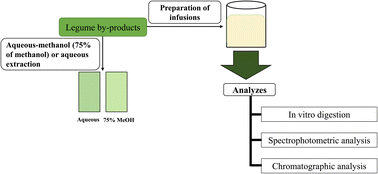
The high bioactive content of legume by-products enables their utilization in the development of value-added food products. Thus, this study explores the valorization of legume by-products (chickpea hulls (CH), faba bean hulls (FH), and lentil hulls (LH)) through the formulation of novel functional infusions. The effects of in vitro digestion on the phenolic content and antioxidant potential of these infusions were assessed. Aqueous-methanolic (75%) and aqueous extracts of these samples were also evaluated in terms of total phenolic content (TPC), total flavonoid content (TFC), and antioxidant capacity. According to the results, FH and LH showed higher TPC (1002 and 1320 mg GAE/100 g, respectively) and TFC (961 and 986 mg CE/100 g, respectively) values (p < 0.05). Similarly, among the infusions (CHI, FHI, and LHI), which were all prepared from their respective samples, the FHI and LHI exhibited higher levels of TPC, TFC, and antioxidant capacity before and after in vitro digestion (p < 0.05). Additionally, comprehensive LC-ESI-MS/MS phenolic profiling showed the great potential for the retention of individual phenolics in newly formulated infusions. These results suggest that legume by-products have great potential for value-added applications as functional ingredients in infusion formulations, contributing to their sustainable utilization and offering health-promoting properties.
- This article is part of the themed collection: Celebrating International Women’s Day 2026: Women in Sustainable Food Technology
 Please wait while we load your content...


